
Project management tools and techniques - definition, examples, and application
Discover the most effective project management tools and techniques, compare Agile and Waterfall, and learn how to improve planning, communication, risk management, and project performance.

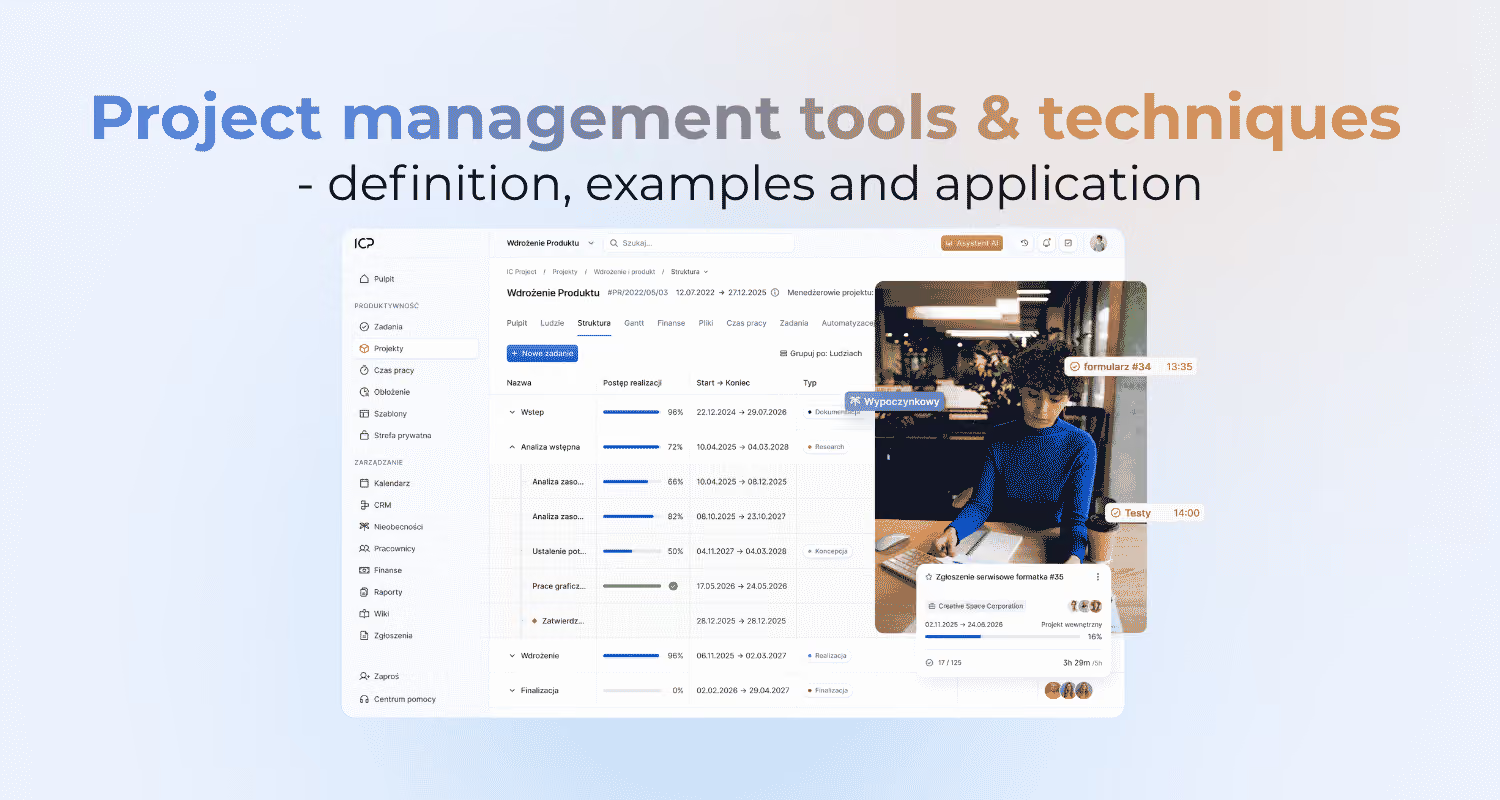
Tell our team about your needs and we will customize the tool as part of your chosen package!
Project management tools and techniques are used to bring order to the work, decisions, and responsibilities within a project. It’s not just about the schedule, but about how you get the team to the goal within a set timeframe and budget. Good project management helps keep scope, deadlines, and costs under control, even when change or uncertainty shows up. In practice, that means choosing the right approach, planning techniques, communication rules, and methods for tracking progress. At the outset, it’s worth understanding the essence of project management itself and the project life cycle, because that’s what gives the rest of the tools their purpose.
The essence of project management: key elements and goals
The essence of project management lies in guiding a team in a structured way from kickoff to completion so it can achieve the agreed goals and success criteria. This approach includes initiation, planning, execution, control, and closure, instead of reacting to problems only once they appear. In practice, that reduces decision-making chaos, makes it easier to coordinate people, and helps you spot sooner when scope, timing, or budget are starting to drift.
The main project goals are to keep scope, time, and budget in balance, deliver business value, reduce risk, maintain good communication, and ensure quality. A project isn’t effective just because the team closed a lot of tasks — it still has to deliver the agreed business outcome. That’s why project management combines planning with ongoing assessment of progress, uncertainty, and stakeholder needs.
Project life cycle: stages from initiation to closure
The project life cycle organizes work into five phases: initiation, planning, execution, monitoring and control, and closure. Each phase involves a different type of decision and a different level of detail. That way, the team knows when it’s defining the purpose of the project, when it’s building the plan, and when it’s reviewing the outcome and drawing lessons from it.
- Initiation — defining the project goal and its business justification,
- Planning — setting the scope, schedule, resources, and risks,
- Execution — carrying out the planned work by the team,
- Monitoring and control — tracking progress, responding to deviations, and managing change,
- Closure — formally completing the project, obtaining acceptance, and capturing lessons learned.
This breakdown matters in practice because different tools work best at the start than during execution and control. Most problems happen when a project kicks off without clear initiation or ends without formal closure. Skipping monitoring is costly too, because changes and delays are noticed too late.
Choosing a methodology: how to pick the right project approach
You choose the right project approach by assessing how much the requirements may change, the time pressure, the complexity, and the team’s way of working. A methodology isn’t just process decoration — it’s the framework for decisions about planning, control, and responding to change. If it’s chosen badly, a project usually loses either predictability or flexibility. The best methodology isn’t the trendiest one, but the one that fits the real conditions of the project.
- variability of requirements and scope,
- how critical the schedule and budget are,
- technological and organizational complexity,
- level of risk tolerance,
- contractual and regulatory requirements,
- team maturity and autonomy.
In practice, a stable, well-understood project is easier to run sequentially, because you can plan stages and acceptance points more precisely. When requirements are expected to evolve, an iterative approach works better because it lets you validate the direction of the work more quickly. If part of the scope is fixed and part is exploratory, a hybrid model is often the sensible choice. That choice still requires clear rules, because without them the team ends up mixing two ways of working and loses control.
Agile vs. Waterfall: which approach should you choose?
Agile is the right choice when the goal is known but the path to it is still uncertain, while Waterfall works when requirements are stable and you need to manage successive stages closely. The difference isn’t just about work style. It affects when decisions are made, how you plan for change, and how often you validate the outcome with the customer. That’s why the choice affects the schedule, budget, reporting style, and stakeholder expectations.
Agile is built on iterative delivery of value and fast feedback. It works well when the team is cross-functional and priorities need regular adjustment. In that setup, tools like a backlog, user stories, story points, and a Kanban board with WIP limits are useful. The benefit of adaptability is real, but the trade-off can be less predictability in the long-term plan.
Waterfall is a good fit when change during the project would be costly or impossible, and formal approvals are mandatory. In that case, a WBS, Gantt chart, and critical path analysis create more value because they organize dependencies and deadlines. This model gives you tighter control, but it handles uncertainty and late adjustments less well. When a project combines fixed requirements with an area where solutions still need testing, a hybrid approach is usually the most sensible option.
Planning and control techniques: tools for effective project management
Planning and control techniques bring structure to a project’s scope, work sequence, priorities, and delivery pace. They help the team understand what needs to be created, in what order, and how to tell whether the work is progressing according to plan. In practice, that cuts down on guesswork, manual arrangements, and arguments about what’s actually urgent.
A good technique isn’t a “one-size-fits-all standard” — it’s a response to a specific project problem. If you need to break a large scope into smaller parts, WBS is useful. If the work evolves iteratively, a product backlog and user stories tend to work better. If dependencies and deadlines are critical, a Gantt chart, roadmap, or critical path analysis will bring more value.
- MoSCoW helps separate must-have items from those that can wait,
- WSJF supports choosing the tasks worth doing first,
- Story Points and Planning Poker bring structure to estimation when uncertainty is high,
- A Kanban board shows the flow of work and where bottlenecks are,
- WIP limits protect the team from overload and slowdowns.
The most common mistake is mixing too many techniques without a clear purpose. The team creates a schedule, a backlog, three reports, and several priority lists, but still doesn’t know what to base decisions on. The second mistake is failing to keep things updated. Even the best plan stops being useful when it no longer reflects changes in scope, deadlines, or workflow.
The role of communication and risk management in project success
Communication and risk management play a major role in project success because they help catch deviations early and quickly agree on how to respond. Without them, even a solid plan loses value, because the team ends up working with incomplete information. In practice, that means having clear rules about who communicates decisions, status updates, and problems to whom.
The foundation of communication is a plan that defines who communicates what, when, and in what format. Dailies, weekly meetings, status reports, and stakeholder communication only make sense when everyone understands their purpose. A single source of truth for decisions, scope, and status reduces chaos faster than adding more meetings.
Risk management means regularly identifying threats and opportunities, assessing their impact, and planning responses. A risk register and a probability-and-impact matrix help distinguish genuinely critical issues from secondary ones. After the assessment, you need to decide whether to avoid, transfer, mitigate, or consciously accept the risk.
Risk the team doesn’t talk about doesn’t disappear — it usually comes back as a delay or a conflict over priorities. A common mistake is creating a risk list at the start of the project and never reviewing it again. That makes it easy to miss scope creep, overloaded work in progress, and the effects of poor collaboration between teams.
Success and performance metrics: how to assess project value
Project value should be assessed through a set of metrics that show not only work progress, but also the real business outcome. Deadlines and costs alone aren’t enough if the result doesn’t deliver the expected benefit or meet quality requirements. The most useful metrics combine three perspectives: project delivery, workflow efficiency, and the value delivered to the end user. That kind of set makes it easier to spot whether the problem lies in the plan, the execution, or the business case behind the whole initiative.
In practice, it’s worth tracking several groups of metrics at the same time:
- on-time delivery,
- budget adherence,
- Cycle Time and Lead Time,
- team throughput,
- business value, for example ROI, NPS, or conversion rate,
- stakeholder or customer satisfaction,
- the number and severity of post-release defects.
Each of these metrics answers a different question, which is why a single indicator rarely gives the full picture. Timeliness and budget show how well the project is under control, while flow metrics show how efficiently the team turns a plan into completed work. Business value and satisfaction metrics verify whether the project made sense for the organization and its audience. Post-release defects show whether delivery speed was achieved at the expense of quality.
The most common mistake is measuring activity alone, such as the number of closed tasks, without any outcome context. That can be misleading, because a high volume of completed work doesn’t automatically mean the project is delivering value. That’s why every metric review should end with a decision about what to speed up, what to limit, and what to change in the priorities.
See more:
Construction Project Management
Also read
Update 09/2026: Even more accurate project planning
September IC Project update: set project duration in days and exclude non-working days from schedules. Plan projects faster and more accurately.
.png)
.png)
Try IC Project in your company
Our team is ready to help!

Create a free account and test with no obligation