
What Is the Difference Between Program and Project Management?
This guide breaks down the core differences, explains when each approach matters, and shows how the right tools—particularly IC Project—can support both project and program management from a single platform.

Tell our team about your needs and we will customize the tool as part of your chosen package!
If you’ve ever managed multiple initiatives at the same time—a product launch, an office relocation, and a marketing campaign, say—you’ve probably felt the tension between keeping individual projects on track and making sure the whole collection of work moves the business forward. That tension is, in essence, the difference between project management and program management.
These two disciplines are closely related, frequently confused, and increasingly important as organizations take on more complex, interconnected work. Understanding where one ends and the other begins isn’t just academic—it has direct implications for how you structure teams, choose tools, and allocate resources.
This guide breaks down the core differences, explains when each approach matters, and shows how the right tools—particularly IC Project—can support both project and program management from a single platform.
Defining the Terms: Project vs. Program
What is a project?
A project is a temporary endeavor with a defined beginning, end, and scope. It has a specific objective—build a website, launch a product feature, complete a construction phase—and is constrained by three fundamental variables: time, budget, and resources. The Project Management Institute (PMI) defines it as a unique effort undertaken to create a distinct product, service, or result.
Projects have clear deliverables. You know when they’re done. A project to redesign your company’s onboarding flow, for example, has a start date, a delivery date, a team, and a measurable outcome. For a deeper look at how to manage projects effectively, IC Project’s guide on successful project management covers the fundamentals.
What is a program?
A program is a group of related projects managed in a coordinated way to obtain benefits and control not available from managing them individually. Programs are ongoing, strategic, and focused on long-term outcomes rather than individual deliverables.
Consider a company rolling out a new product line. That program might include projects for product development, marketing campaign creation, supply chain setup, sales team training, and customer support preparation. Each is a project with its own timeline and scope, but they’re all part of a larger program that only succeeds if the pieces work together.
Program management is about orchestrating those interdependencies—ensuring that a delay in one project doesn’t cascade across the others, and that the collective output delivers on a strategic business objective.
Key Differences: Program Management vs. Project Management
While the two disciplines share common ground (planning, execution, monitoring), they differ in several fundamental ways:
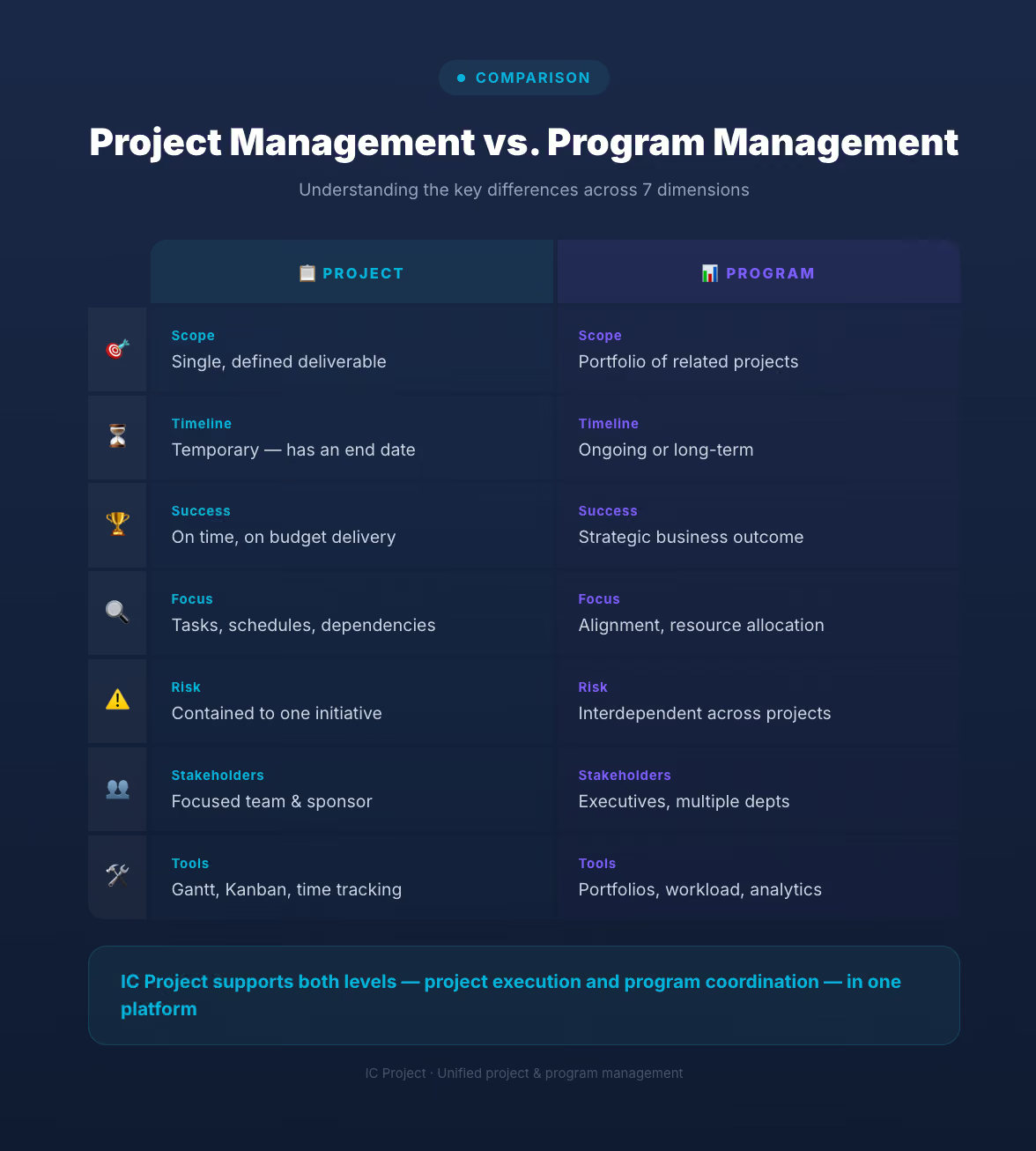
Scope. Project management focuses on a single, defined deliverable. Program management oversees a portfolio of related projects whose scopes may evolve as business needs change.
Timeline. Projects are temporary—they have an end date. Programs are often ongoing or long-term, with projects being added, completed, or adjusted throughout the program’s lifecycle.
Success metrics. A project succeeds when it delivers its planned outcome on time and within budget. A program succeeds when its combined projects achieve a strategic business goal—revenue growth, market expansion, digital transformation.
Management focus. Project managers focus on execution: tasks, schedules, dependencies, and deliverables. Program managers focus on alignment: ensuring that individual projects serve the larger strategic vision and that resources are allocated effectively across the portfolio.
Risk management. In project management, risks are typically contained within a single initiative. In program management, risks are interdependent—a supply chain delay in one project might impact the launch timeline of another. PMI data shows that companies with mature program management lose 28 times less money on failed initiatives.
Stakeholder complexity. Projects typically have a focused stakeholder group. Programs involve executive leadership, multiple department heads, and sometimes external partners—requiring more sophisticated communication and reporting structures.
Understanding project management methodologies is essential for both roles, though program managers need to be fluent across multiple approaches since different projects within their program may use different frameworks.
When You Need Project Management vs. Program Management
Not every organization needs formal program management. Here’s how to think about which approach fits your situation:
You need project management when you’re running a single initiative with a clear scope, timeline, and team. This covers the majority of work in small and mid-sized companies: building a website, executing a marketing campaign, developing a product feature, or managing a construction phase. Good project management tools—Gantt charts, Kanban boards, task assignments, time tracking—are sufficient. IC Project’s Gantt chart capabilities are particularly useful here for visualizing timelines and dependencies.
You need program management when multiple related projects must be coordinated to achieve a common strategic objective. Signs that you’ve crossed this threshold include: projects that share resources and create scheduling conflicts, deliverables from one project that serve as inputs for another, executive leadership asking for portfolio-level visibility rather than individual project updates, and budget allocation decisions that span multiple initiatives.
For organizations collaborating across content teams, departments, and external stakeholders, the shift from project to program management often happens gradually—and the right tooling makes that transition significantly smoother.
The Role of the Project Manager vs. the Program Manager
The skills overlap, but the day-to-day work looks quite different.
Project managers are focused on execution. They create detailed plans, assign tasks, manage timelines, track budgets, resolve blockers, and communicate progress to stakeholders. They live in the details—every task, every dependency, every deadline. The best project managers combine technical planning skills with strong people management. IC Project’s article on project manager personal development explores the competencies that set top performers apart.
Program managers operate at a higher altitude. They coordinate across project managers, manage interdependencies between projects, allocate shared resources, and ensure that the collection of projects stays aligned with organizational strategy. They spend more time in executive conversations, less time in task-level detail.
In practice, many organizations—especially small and mid-sized ones—have people wearing both hats. A marketing director might manage the overall program (brand relaunch) while also directly managing one of the component projects (website redesign). This is where unified tools become essential: you need one platform that works at both the project and program level.
The PMI Data: Why Both Disciplines Matter
The Project Management Institute’s research paints a clear picture of the impact that disciplined project and program management has on business outcomes.
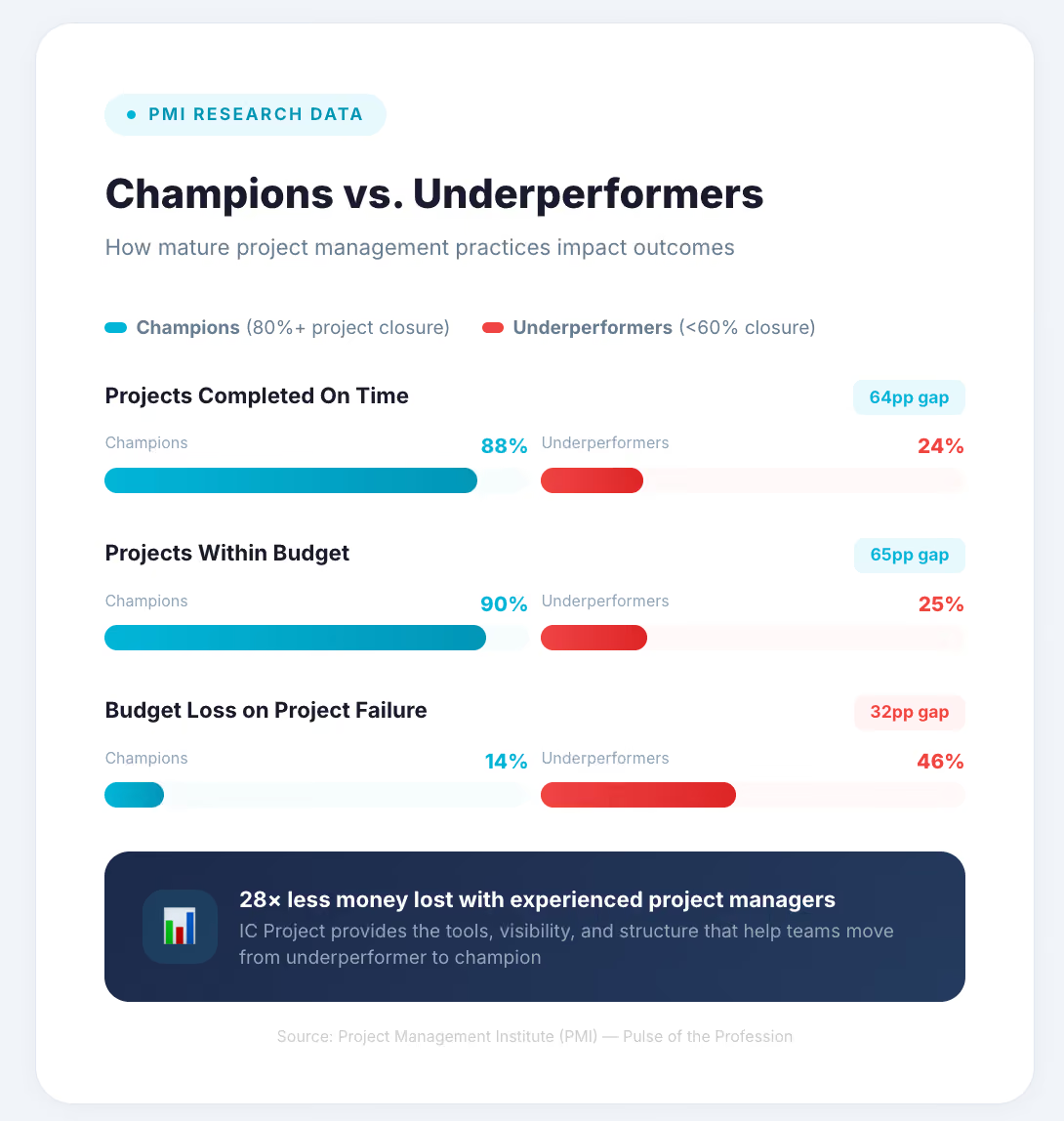
Companies classified as “Champions”—those with mature management practices, proper tools, and experienced managers—complete 88% of projects on time and 90% within budget. When a project does fail, their losses average just 14% of the allocated budget.
By contrast, “Underperformers”—organizations without proper management discipline—complete only 24% of projects on time, 25% within budget, and lose an average of 46% of the budget when projects fail. The gap between these two groups is enormous, and it’s driven largely by the presence (or absence) of proper management tools and processes.
IC Project’s analysis of project management expectations vs. reality digs into why this gap exists and how organizations can close it. The short version: fragmented communication, lack of visibility, and poor resource allocation are the top culprits.
These challenges multiply at the program level. When you’re coordinating five or ten interconnected projects, the consequences of poor visibility and miscommunication aren’t just additive—they’re multiplicative. A resource conflict in one project can create cascading delays across the entire program.
Real-World Examples: Project vs. Program in Action
Construction. A single building project (foundation, framing, electrical, finishing) is project management. A multi-phase real estate development with residential, commercial, and infrastructure components—sharing contractors, timelines, and regulatory approvals—is program management. IC Project’s construction industry solutions handle both levels, from individual site management to multi-project portfolios.
Marketing agencies. A client campaign (strategy, creative, media buying, reporting) is a project. Managing all client accounts and internal initiatives across the agency—with shared creative resources, concurrent deadlines, and capacity planning—is program management. IC Project is a favorite tool for marketing agencies precisely because it handles this dual reality.
Product development. Building a single feature is a project. Managing a product roadmap with concurrent feature development, infrastructure work, QA streams, and coordinated releases is a program. For any team managing complex product work—whether developing an AI receptionist kiosk or enterprise software—the distinction between project and program management determines how you structure your team and tools.
Manufacturing & supply chain. Fulfilling a specific production order is a project. Coordinating production planning, procurement (including navigating challenges like MLCC shortage alternative sourcing), quality assurance, and logistics across multiple product lines is program management. IC Project’s industrial automation capabilities provide the multi-project visibility that manufacturing programs require.
Technology deployment. Implementing a single OpenClaw deployment service instance for a client is a project. Coordinating multi-site rollouts, integration with existing systems, user training, and post-launch optimization across regions becomes a program.
How IC Project Supports Both Project and Program Management
One of the biggest practical challenges organizations face is tooling. Many teams use separate tools for individual project management and portfolio oversight, creating data silos and forcing managers to constantly switch contexts. IC Project takes a different approach: one unified platform that works at both the project and program level.
At the project level, IC Project provides everything you need for day-to-day execution: task management with Kanban boards, list views, and calendar views; Gantt chart scheduling with dependencies and milestones; built-in time tracking that automatically converts hours into costs; team communication through messenger, comments, and notifications; and file management with support for multiple formats. Every team member knows what to do and when to do it.
At the program level, IC Project provides the cross-project visibility that program managers need: a global Gantt chart showing all projects on a single timeline; the workload module that visualizes team capacity across all projects with color-coded availability indicators; project budgets and profitability analysis that let you compare financial performance across the portfolio; custom fields and reporting that adapt to your organization’s specific processes; and PMO-level tools including portfolios, analytics, and automations.
What makes IC Project particularly effective is that these aren’t separate modules bolted together. They’re integrated functions within a single system. When a task is updated in an individual project, the impact is immediately visible in the global timeline, the workload charts, and the financial reports. This eliminates the double-entry and information lag that plagues organizations using multiple disconnected tools.
IC Project also stands out in its implementation approach. Unlike generic tools built for everyone, IC Project is shaped by real operational needs. You get a dedicated specialist who analyzes your processes, configures the system, and trains your team—ensuring that the tool actually fits how your organization works, rather than forcing you to adapt to the software.
Making the Transition: From Project Thinking to Program Thinking
If your organization is growing beyond individual projects and starting to face the challenges of cross-project coordination, here are practical steps for making the transition:
Map your project interdependencies. Before implementing program management, understand how your current projects relate to each other. Which ones share resources? Which ones have dependent deliverables? This mapping exercise reveals the complexity you’re already dealing with.
Establish portfolio visibility. Start by getting all projects into a single system. IC Project’s global Gantt chart and workload module provide this visibility without requiring you to restructure your teams or processes. Just seeing everything in one place often surfaces insights that were previously hidden.
Define program-level metrics. Move beyond individual project KPIs to metrics that measure strategic outcomes. Are all the projects in your product launch program collectively moving toward the revenue target? Is the digital transformation program actually reducing operational costs?
Invest in cross-project communication. The messenger, comments, and notification system in IC Project ensures that information flows between project teams, not just within them. This is often the single biggest improvement organizations make when transitioning to program management.
Start simple, then scale. You don’t need to implement a full PMO overnight. Begin with project-level tools, add cross-project visibility, and gradually build program management practices as your organization matures. IC Project grows with your business, supporting this incremental approach with flexible configuration and scalable features.
The Bottom Line
The difference between project management and program management isn’t just a matter of scale—it’s a difference in mindset. Project management is about delivering a specific result. Program management is about ensuring that a collection of results adds up to something strategically meaningful.
Both disciplines are essential, and the most effective organizations master both. The good news is that you don’t need separate tools, separate teams, or separate processes to do it well. With a unified platform like IC Project that works at both the project and program level, you can manage individual tasks with precision while maintaining the strategic visibility that keeps your entire organization moving in the right direction.
Ready to bring your projects and programs under one roof? Try IC Project and see how a unified management platform transforms the way your team works.
Also read
Update 09/2026: Even more accurate project planning
September IC Project update: set project duration in days and exclude non-working days from schedules. Plan projects faster and more accurately.
.png)
.png)
Try IC Project in your company
Our team is ready to help!

Create a free account and test with no obligation