
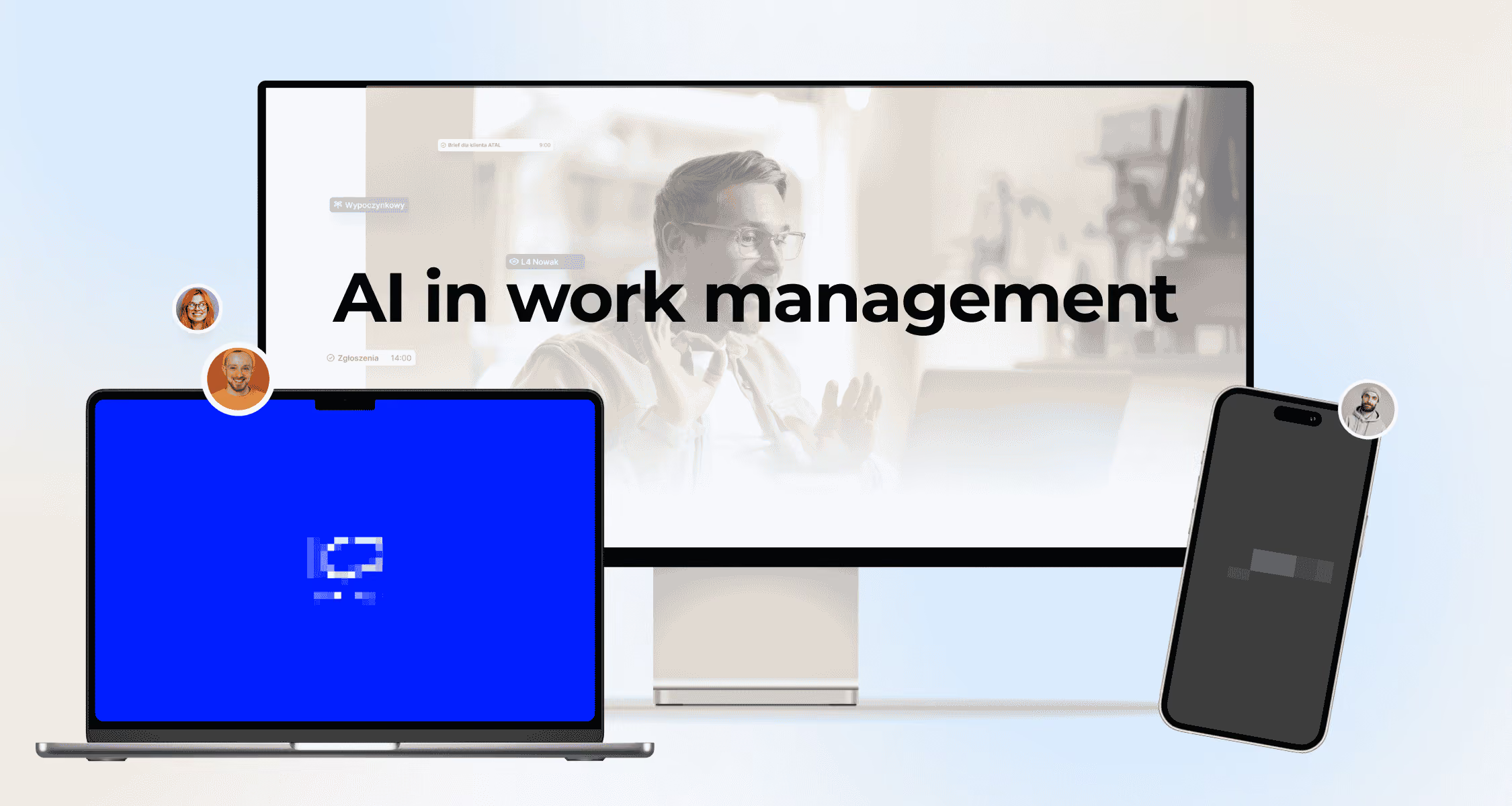
AI in work management — how medium-sized and large companies can speed up and organize everyday life
Optimize the efficiency of your team with AI in work management. Learn how technology can improve outcomes. Read the article!

Tell our team about your needs and we will customize the tool as part of your chosen package!
Since the launch of ChatGPT at the end of 2022 and the expansion of Copilot functionality from Microsoft and Google, artificial intelligence has ceased to be just a technological curiosity straight out of science fiction. It has become a real tool that companies around the world have begun to integrate into the daily work of teams numbering hundreds or thousands of employees. Tools such as ChatGPT have been designed to use the resources of the internet to effectively support users in their daily tasks. The concept of artificial intelligence emerged in the 1950s, and since then, the technology has been developing dynamically. In business, artificial intelligence is becoming a key element of development strategies, and its practical significance for AI in business lies in optimizing processes, increasing efficiency, and generating greater profits. The topic of AI is present in both education and business practice, and access to modern tools is now at the fingertips of every company, regardless of size.
We will discuss the use of AI tools and systems for organizing work at the level of the entire company, departments, and project teams, with a particular focus on AI-assisted tools.
Why AI is radically accelerating work in corporations and large companies
In organizations with more than 100 employees, the greatest losses of time stem from three main sources: scattered communication, repetitive reports and statuses, and unclear priorities. The broad capabilities of AI include automation and streamlining work in these areas, enabling more effective management of business processes. The practical aspects of AI implementation in large companies show how important it is to implement and use artificial intelligence in various departments of an organization in order to meet the challenges of new working conditions and increase innovation.
The scope of AI covers not only the automation of repetitive tasks, but also support in report creation, data analysis, and project management. AI not only analyzes data, but also draws conclusions, supporting business decision-making. Effective AI implementation requires managers and employees to acquire the skills necessary to adapt to new conditions and manage AI technology, which translates into the development of future competencies. The skills necessary to use artificial intelligence are crucial for business development, as they enable companies to respond quickly to market changes and implement innovative solutions. This is where AI solutions provide the fastest return on investment – because they tackle problems that affect literally every department.
Common time-killers in large companies
Before implementing any innovative solutions, it is worth identifying what actually consumes your teams' time:
- Hours-long status meetings
- Manual summaries of meetings and projects
- Transcribing data between systems
- Endless email threads requiring analysis
Generative AI (ChatGPT, Microsoft Copilot, Google Gemini for Workspace) drastically reduces these activities. These tools enable the generation of answers to questions, the creation of letters and other documents, as well as automatic meeting summaries, correspondence summaries, and document draft generation—tasks that a year ago required hours of work, but today take minutes. AI can also translate and analyze foreign texts, which supports the work of international teams. Thanks to its advanced computational capabilities, AI allows for fast data processing and automation of many processes. What's more, the quality of content generated by AI can be on par with that of a professional copywriter, which significantly increases the effectiveness of marketing and communication activities.
Specific labor market figures
According to a 2025 study, employees save an average of 1.5–2.5 hours per week thanks to AI in tasks such as calendar organization, data entry, internal communication management, and automation of processes such as report generation. Artificial intelligence also supports the completion of certain tasks that would previously have been entrusted to contractors or other employees, which further speeds up the work of teams. The BCG report indicates that in the areas of corporate communication, 26-36% of time can be reclaimed for more strategic work.
A simple example: thanks to artificial intelligence, the marketing department of a 300-person company can generate the first versions of offers, briefs, and presentations in a few dozen minutes instead of several hours. This translates into a 20-30% time savings for creative teams.
AI-powered project management tools also combine data from multiple sources into a single “command center.” With the knowledge we have gathered through it, teams can make faster decisions based on up-to-date information—instead of searching for it in spreadsheets, emails, and instant messengers scattered throughout the company.
Automatic scheduling and prioritization
Advanced project management systems offer features that until recently were the stuff of imagination for planners. They use the advanced computational capabilities of artificial intelligence to analyze dependencies and optimize schedules:
- Algorithms suggesting task order – based on dependencies, deadlines, and availability of people
- Identification of bottlenecks – AI indicates where the project may get “stuck”
- Detection of overloads – the system signals when a specific person has too many tasks at once
- Intelligent scheduling – AI suggests deadlines and identifies conflicts in calendars
Transparency for management
AI generates clear progress summaries—project statuses, burn-down charts in simple language—for managers and executives. Artificial intelligence supports the creation of reports that are clear and accessible in real time. Instead of weekly status meetings, you can have automatic reports showing:
- What is causing delays?
- Where are the risks?
- What requires immediate attention?
Fewer meetings, more decisions based on real-time data.
AI tools in everyday office work: from Copilot to IC Project
Polish companies and corporations around the world rarely start by building their own AI models. First, they use ready-made tools: text assistants, integrations with office suites, work management systems, and chatbots developed by industry leaders, such as ChatGPT—a chatbot developed by OpenAI that generates responses to user questions and supports various business tasks.
AI is also increasingly supporting social media activities, enabling communication automation, data analysis, and increased marketing strategy effectiveness.
However, in order to effectively use AI tools in work management, it is essential to provide appropriate training for employees.
IC Project as a central board organizing work
In practical applications, the role of a system that serves as a single source of truth proves to be crucial. IC Project can act as a “central command panel”: all tasks, projects, and deadlines in one place, with an AI layer helping with reporting and work planning.
For HR, IT, and marketing departments, this means no more jumping between dozens of applications. Project management specialists can see the full picture without having to query each team separately.
Critical thinking in work management
In the era of AI solutions, critical thinking is becoming one of the most important skills for both managers and all employees. Artificial intelligence can instantly analyze data, generate reports, and suggest decisions, but it is up to humans to assess whether the answers generated by AI are actually accurate and useful in a given context. Critical thinking not only allows us to identify potential errors or inaccuracies in AI analyses, but also to ask the right questions and interpret the results in light of the company's business objectives.
In practice, this means that when implementing AI solutions, companies should invest not only in new technologies, but also in the development of analytical and critical thinking skills among their employees. It is these competencies that allow them to effectively leverage the potential of AI, make better decisions, and minimize the risk of errors. Critical thinking is essential to understand the limitations of AI tools, interpret data correctly, and maintain control over business processes. Modern AI solutions can be a huge support, but it is people—equipped with the ability to critically analyze—who determine their effective use in everyday work.
The synergy of humans and AI in everyday work
The collaboration between humans and AI in everyday work is one of the key factors for success in modern organizations today. Artificial intelligence does not replace employees, but becomes their partner, supporting them in performing tasks, making decisions, and professional development. On the contrary, AI strengthens the role of humans in the organization, allowing them to focus on more strategic and creative aspects of their work. Thanks to AI solutions, it is possible not only to increase productivity, but also to improve the quality of professional life – fewer routine tasks, more time for creativity and development.
In practice, the synergy between humans and AI means that employees can use AI tools to automate repetitive tasks, quickly search for information, or generate reports. Managers, in turn, gain access to advanced analytics that help them better manage teams and human resources. AI also supports communication and collaboration in distributed teams, enabling efficient knowledge sharing and rapid response to change.
The greatest value, however, is that AI allows employees to focus on tasks that require creativity, empathy, and critical thinking—tasks in which humans are irreplaceable. Artificial intelligence takes over tedious, repetitive processes, allowing people to develop their skills and pursue ambitious projects. It is this synergy that allows companies to fully exploit the potential of AI and gain a competitive advantage in the labor market.
Limitations on the use of artificial intelligence
Although artificial intelligence opens up a wide range of new opportunities for companies, it is important to remember its limitations. One of the most significant challenges is the fact that AI is not always able to correctly interpret the nuances of human communication or specific business contexts. This can lead to situations where AI solutions generate responses that are formally correct but substantively inaccurate or inadequate for the real needs of the company.
Another limitation is the quality of data entry—AI systems are only as effective as the data they work with. If incomplete, incorrect, or outdated information is fed into the system, even the most advanced artificial intelligence will not be able to generate valuable analyses or recommendations. It is also worth remembering ethical and legal aspects, such as the protection of personal data or the prevention of unintended discrimination in decision-making processes.
Therefore, when implementing AI solutions, companies should not only invest in technology, but also ensure appropriate data quality control processes, regular validation of results, and training for employees on the ethical use of AI. Awareness of these limitations allows for better risk management and full utilization of the potential of artificial intelligence in everyday work.
From pilot to daily routine: how to implement AI in work management
AI in a company does not start with a “big transformation.” It starts with small, well-chosen pilot projects in selected departments—marketing, HR, and PMO are typical starting points. However, effective AI implementation and deployment requires the skills necessary to manage change and adapt to new business conditions.
If you want to learn how to implement AI in work management step by step, this book will suggest practical solutions and point you toward proven courses of action.
The future of artificial intelligence in work management
The future of work management in the AI era promises to be extremely dynamic. AI technologies will become increasingly integrated with other modern solutions, such as the Internet of Things and blockchain, enabling even greater automation, security, and efficiency of business processes. Artificial intelligence will not only support data analysis and decision-making, but will also enable companies to respond quickly to market changes and manage risk better.
At the same time, with the development of AI, the importance of soft skills—such as critical thinking, creativity, and social skills—is growing. It is employees equipped with these skills who will be able to take full advantage of the capabilities of AI, interpret analysis results, and make the right decisions in new business conditions. Companies that are already investing in the development of their teams and implementing innovative AI solutions will gain a competitive advantage in the labor market of the near future.
In the age of AI, it will be crucial not only to implement new technologies, but also to build an organizational culture based on openness, learning, and continuous improvement. The future belongs to those organizations that can combine the potential of AI with the competencies of their employees, creating an environment conducive to innovation and business development.
Summary: AI as a natural part of modern work management
In the age of AI, there is no longer any place for treating artificial intelligence as an “innovative project.” It is a layer that should permeate everyday office tools in medium and large companies—just as email and instant messaging permeated them a decade ago. Artificial intelligence offers unlimited possibilities for companies, supporting business development and process automation.
Two main benefits
- Significant acceleration of task completion – several dozen percent less time spent on routine tasks (reports, statuses, information searches)
- Better work organization – one well-organized system (e.g., IC Project) supported by AI, instead of the chaos of dozens of applications
In conclusion
AI is changing the job market – that's a fact. But it's not about electronic super brains replacing humans. It's about the fact that combining a robust project management system with AI features is one of the fastest ways to improve efficiency in everyday corporate work today.
Thanks to artificial intelligence, Polish companies can compete with the best in the world – provided that they approach AI practically, step by step, with our experience and awareness of both its potential and potential risks.
The first step? Organize your work in one system. The rest will come naturally.
Also read
Update 09/2026: Even more accurate project planning
September IC Project update: set project duration in days and exclude non-working days from schedules. Plan projects faster and more accurately.
.avif)
.avif)
Try IC Project in your company
Our team is ready to help!

Create a free account and test with no obligation