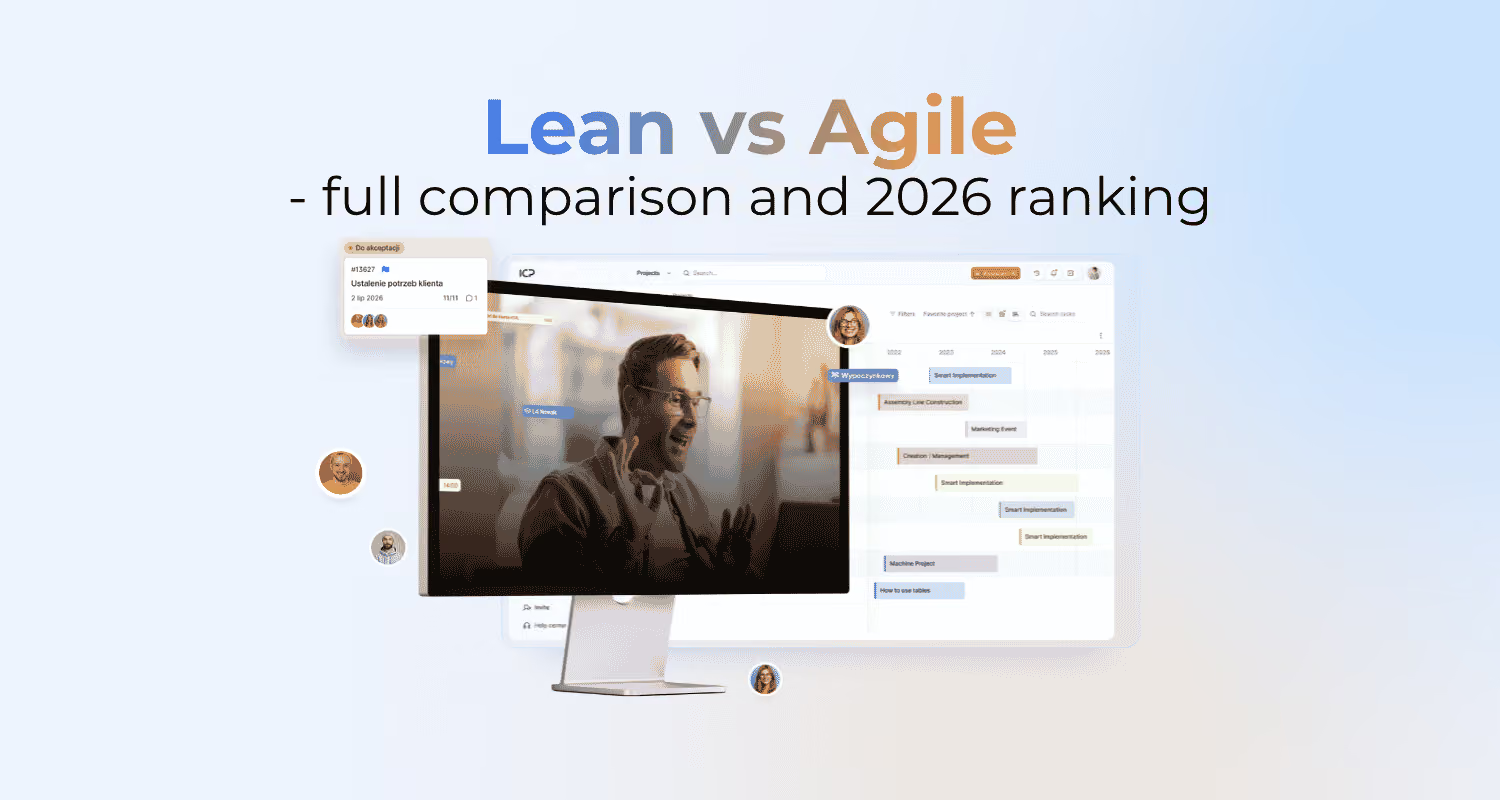
Lean vs Agile - full comparison and 2026 ranking
Lean vs Agile explained: discover the key differences, benefits, limitations, and when to choose each methodology for better workflow and delivery.

Tell our team about your needs and we will customize the tool as part of your chosen package!
Lean and Agile help teams deliver work faster, but they solve different operational problems. The key question is simple: what hurts more — workflow issues or uncertainty in the requirements. In the 2026 ranking, there’s no single winner, because effectiveness depends on context. For project leaders and marketing operations teams, what matters is queues, feedback, priorities, and visibility into workload.
Main differences between Lean and Agile
Lean focuses on workflow, while Agile focuses on how well a team adapts to change. Lean asks where work is waiting, getting stuck, or losing value because of unnecessary steps. Agile asks what the team should learn in the next cycle so the outcome fits business needs better.
In practice, Lean works best where the process is repeatable but too slow or overloaded. Agile works better when requirements are uncertain and decisions need to come from frequent feedback. Both approaches rely on small batches of work, visible tasks, and regular improvement.
- Lean improves lead time, WIP, queues, and blockers,
- Agile improves response to feedback, priorities, and learning,
- Lean works well for steady campaign, content, and approval pipelines,
- Agile works well for tests, experiments, and changing assumptions,
- Lean-Agile combines flow control with iterative value delivery.
The simplest rule of thumb is practical: if flow is the problem, choose Lean; if uncertainty is the problem, choose Agile. If the team has both problems, a hybrid approach makes more sense. That’s why, in the 2026 comparison, Lean-Agile usually comes out on top for knowledge teams and marketing operations.
How the Lean methodology works
Lean works by mapping the process, spotting waste, and shortening the path work takes through the system. The team looks not just at individual tasks, but at the entire flow from intake to delivery. That makes it easier to see where work is waiting, bouncing back for rework, or overloading people.
The most important Lean mechanism is limiting work in progress, or WIP. When a team starts too many tasks at once, the number of handoffs, delays, and blockers goes up. A WIP limit forces the team to finish work before taking on more.
Lean also requires standardising good practices, but that doesn’t mean rigidity for the sake of control. A standard shows the best known way the work is currently done. The team then measures lead time, cycle time, throughput, and the number of blockers so it can improve the process based on facts.
How the Agile methodology works
Agile works through short work cycles, a prioritised backlog, and regular feedback from stakeholders. The team doesn’t try to lock down the full scope at the start. Instead, it picks the most important items, delivers partial value, and checks what needs to change next.
The backlog organises work by business value, not by the order requests came in. The product owner or business owner sets priorities, the facilitator keeps the process on track, and the team is responsible for delivery. A review of results shows whether the work is heading in the right direction. A retrospective is there to improve how the team works together, not just to talk about problems.
Agile only makes sense when decisions can change based on feedback. If the decision-maker is unavailable, priorities are unclear, or every change gets pushed onto the team without control, the method loses its effectiveness. At that point, the rituals may look right, but they won’t improve either value or predictability.
When to choose Lean and when to choose Agile
Choose Lean for flow problems, and Agile for uncertainty in requirements. Lean helps when work gets stuck in queues, comes back for rework, or overloads the team. Agile helps when a product, campaign, or solution needs to be built iteratively. A hybrid approach makes sense when a team is dealing with both changing assumptions and operational bottlenecks at the same time.
- A lot of work in progress, queues, and downtime — Lean,
- Uncertain requirements and a need for fast feedback — Agile,
- Steady campaign, content, and approval pipelines — Lean,
- Tests, experiments, and campaigns with changing assumptions — Agile,
- Flexible priorities and workload control — Lean-Agile,
- Stable scope, formal stages, and low variability — Waterfall.
The practical 2026 ranking puts Lean-Agile at the top for knowledge teams and marketing operations. That comes from combining two needs: fast delivery and flow control. Agile holds a strong position for experiments and work with high uncertainty. Lean remains the best choice where the main goal is to shorten the time work takes to move through the system.
Lean-Agile as a combination of best practices
Lean-Agile combines flow control with iterative value delivery. In practice, that means the team limits WIP but still works in short cycles. That helps it spot blockers faster and shift priorities based on feedback. It’s the best choice when a team is struggling with both operational bottlenecks and changing requirements at the same time.
In marketing operations, this combination fits teams that run steady campaign, content, and approval pipelines while also testing new assumptions in parallel. Lean brings structure to workflow statuses, work-in-progress limits, and workload visibility. Agile adds a backlog, prioritisation, outcome reviews, and retrospectives. Without that balance, a team can be fast but chaotic, or organised but too slow to respond to change.
- One work board with clear workflow statuses,
- A backlog organised by business value,
- WIP limits for key stages of the work,
- Regular reviews of outcomes with stakeholders,
- Dashboards showing lead time, blockers, and workload,
- Retrospectives that end with specific improvements.
Roles need to support both dimensions of the work. The product owner or business owner sets priorities, the process lead watches the flow, and the facilitator looks after how the team works together. The team is responsible for delivering value and raising blockers before they turn into delays. In the practical 2026 ranking, Lean-Agile takes first place for exactly this reason: it combines flexibility with control over the work system.
The Most Common Mistakes and Limitations in Using Lean and Agile
The most common mistakes in Lean and Agile come from confusing activity with value and from a lack of operational discipline. A team may have a board, meetings, and status updates, and still do nothing to remove blockers. It may also change priorities so often that it loses all predictability. A methodology won’t fix the way work gets done if no one is making decisions based on metrics and feedback.
- Too much work in progress,
- No clear owner of priorities,
- Changes reaching the team with no control,
- No measurement of lead time, cycle time, or blockers,
- Retrospectives with no follow-up improvement actions,
- Agile rituals with no impact on the value being delivered.
Lean has its limits when it’s treated as cost-cutting instead of flow improvement. It requires measurement, watching queues, and consistently limiting WIP. When product uncertainty is high, Lean on its own may not be enough, because it doesn’t solve the need for frequent learning.
Agile loses effectiveness when the decision-maker is unavailable and priorities stay unclear. At that point, the backlog turns into a wish list, and work cycles stop improving alignment with business needs. The safest fix is to simplify the rules, clearly assign decision owners, and measure the outcomes of the work, not the number of meetings.
Key Performance Indicators (KPIs) in Lean and Agile
KPIs in Lean and Agile should measure flow, predictability, feedback, and the value actually delivered. Without them, a team judges the method by the number of meetings, status updates, or closed tasks. That creates a false sense of control, because activity doesn’t necessarily mean progress.
In Lean, the most important metrics are the ones that show how work moves through the system. Lead time tells you how long it takes from request to delivery. Cycle time shows the time spent actively working on the task, while WIP reveals overload and too many tasks started at once. Throughput helps show how much work the team actually finishes in a given period.
- Lead time — the time from request to delivery,
- Cycle time — the time spent actively working on a task,
- Throughput — the number of completed work items,
- WIP — the amount of work started but not yet delivered,
- Number of blockers — a signal of flow problems,
- Rework — the scale of fixes and work coming back to the team,
- Feedback response time — how quickly the team learns from feedback.
In Agile, the same data needs to be read through the lens of learning and priorities. Delivery predictability shows whether short cycles help plan work without pretending there’s certainty. Feedback response time shows whether reviewing outcomes actually changes decisions. The best KPI set combines flow measurement with value assessment, because then you can see both the speed and the point of the work being delivered.
See more:
Agile methodology - definition, examples, and application
Agile project management in 2022
SAFe Agile - definition, examples, and application
Project management methodologies - definition, examples, and application
Also read
Update 09/2026: Even more accurate project planning
September IC Project update: set project duration in days and exclude non-working days from schedules. Plan projects faster and more accurately.
.png)
.png)
Try IC Project in your company
Our team is ready to help!

Create a free account and test with no obligation